 SleepBit
Are Sleep Bruxism and Sleep Apnea Connected?
They can coexist, but one should not automatically be called the cause of the other.
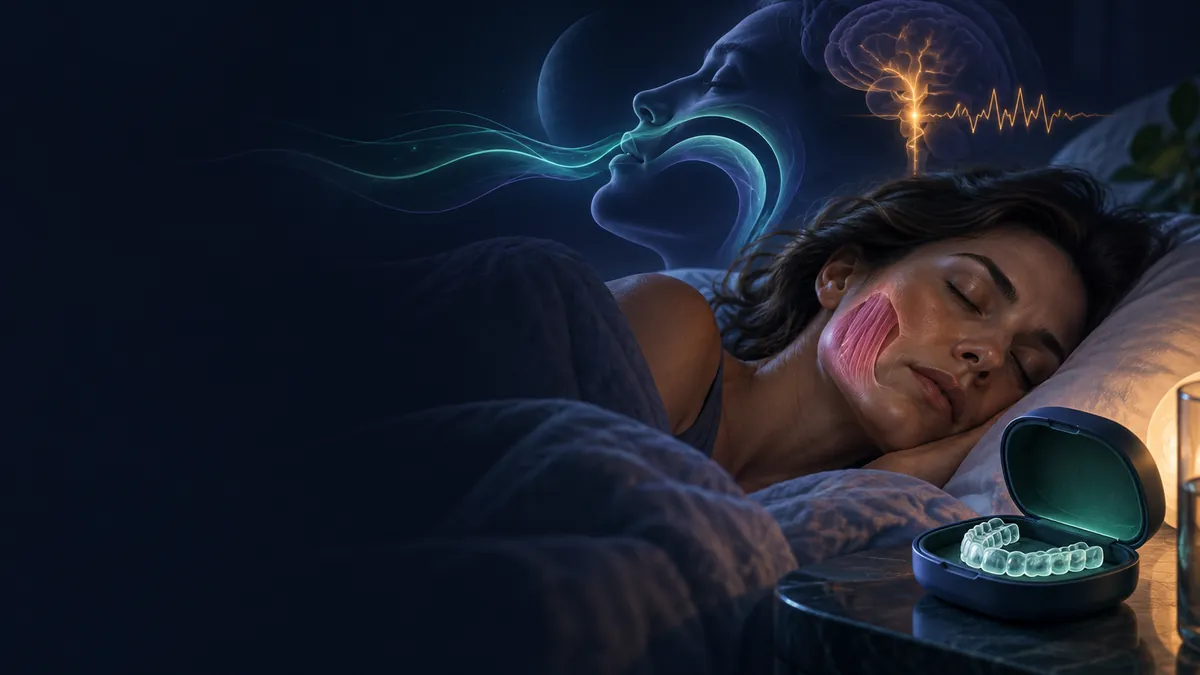
Sleep bruxism involves repeated jaw-muscle activity with clenching or grinding. It can occur around arousals in OSA, but stress, medicines and dental factors also contribute.
What the evidence says
A recent umbrella review found a signal of coexistence but concluded that heterogeneous, low-quality evidence cannot establish causal direction. Tooth wear alone cannot diagnose OSA.
What to do
Track jaw pain, morning headache and tooth wear together with snoring, witnessed apnea and sleepiness. Dental and sleep clinicians can separately address tooth protection and breathing assessment.
Use caution
A night guard may protect teeth but does not replace OSA treatment. Do not reposition the jaw with an unsupervised online device.
Put the reasoning together
Morning jaw pain plus snoring does not prove bruxism caused OSA. Evaluating both problems separately protects the teeth without missing airway disease.
A common misconception
Myth: a bruxism guard also treats OSA. A protective guard and a mandibular advancement device have different purposes and designs.
How to use this information
An association between two conditions does not prove that one causes the other. Record shared triggers and timing, then evaluate each condition by its own criteria. Both may improve after one intervention without proving causation. Continue prescribed care and seek prompt attention for chest pain, neurologic symptoms or severe breathing difficulty instead of waiting for more sleep data.
Next-step checklist
- Track dental and breathing symptoms separately
- Use dental and sleep expertise appropriately
- Do not mistake a guard for airway treatment
Bottom line
Bruxism and OSA can share a night without being the same disorder. Use purpose-specific evaluation and treatment.
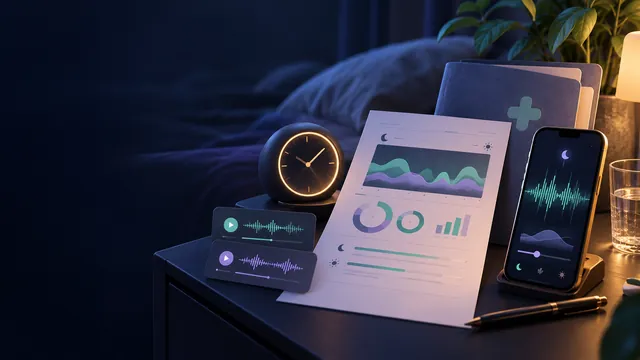
SleepBit records can make a clinical conversation more precise. Diagnosis and treatment changes should be decided with a clinician.